I woke up in the morning with basically no energy from a long day yesterday, forced myself to run, and mysteriously ended up gaining more energy than I had expended before the run before proceeding to go to the gym while somehow forgetting to bring my gym card with me…
Only to have the nice girl who works near the front of the gym (who is also one of my ARC readers for The Little Robot That Could Paint – thank you Christina!!!!) let me in so I could add another day to my ongoing workout streak of… What was it?
Yeah, it’s 1502 days straight that I’ve gone to the gym straight (or exercised) without losing my streak.
a fitness influencer I am not
Uh, a fitness influencer I am not, but if I don’t go to the gym, it just feels… Wrong?
Incidentally, I hope you don’t think this means that I’m some hyper-disciplined machine thing, because that couldn’t be further from the truth.
I’ve failed at a ton of things, but somehow, this is one of those things that’s stayed long enough that it’s become a habit – by no means is it or has it ever been the case that I’ve just been hanging out, doing my thing, keeping at perfection no matter the circumstance; no way freaking Jose, that has NOT been me.
I failed at consistently posting on YouTube (I am monetized, though!) albeit partly because there’s not enough content about ergonomic chairs to make (lol wait till you discover my second persona), failed at writing consistently in the past, failed at X, Y, Z, W, a, b, c, you name it! Some of these things are things that I’d definitely like to come back to (like YouTube), while others are things that I think I’ll be leaving behind for now…
But none of that changes the fact that I maintain a very healthy respect for showing up consistently.
Showing up helps you build a compounding effect, yes, and it would be clichéd if I were just to mention that that’s all it does; I’ll speak about that a little bit more in context of the thing I can actually say that I kept with for now.
Showing up has taught me that yes, showing up does help a TON in bringing you to where you want to go (mainly because I realized that working out and exercising is something that you absolutely have to make into an equilibrium if you truly want sustainable results), but it’s equally taught me that if you try to get to where you want to go without a sense of intention and merely abide by the idea that things can be automated away, you’re going to get nowhere and will just get swept in the wind.
For example, while I was working up somewhere during days 1350 and 1420, I remember that I was gaining a ton of weight – why so? I was treating the exercise just as a means to an end, a process that I had to get to, while neglecting my diet and sleep (which I *currently* need to improve).
I was going through the motions and believing somehow (and very wrongly) that there wasn’t a need for planning and thinking, that essentially as long as I put in the bare minimum each day, everything was peachy keen and great.
It was not.
I gained weight, lost self-motivation, experienced some depression (granted, once again, there was a breakup at the time), and just let myself go… Even though I was working out every single day and hadn’t missed a day.
Does it seem strange?
Well I’m sorry, but you’ll just have to accept that because that’s what happened T_T
So, you might ask.
If that happened to you despite the fact that you showed up all the time, what’s the value of showing up in the first place?
I guess my answer to that is that it showed me that showing up was merely a necessary condition but it wasn’t a sufficient one – that there were a ton of other things that I had to do in this strange and epic journey towards actually feeling and looking confident in front of a mirror in order to achieve some of the outcomes that I seek to achieve for my life…
Something that’s made me try to spend my time a lot more efficiently (and you would know what I mean if you’ve seen me in real life before).
Anyway, speaking of spending time… I spent maybe seven hours talking to different people earlier before heading over to the church that I currently attend, the Damansara Utama Methodist Church; one of the more intense days that I’ve had here in a while, but definitely something very much welcome.
The result of that epic day?
I think I’m going to have an awesome sleep tonight.
Goodnight dear readers, and thanks for reading my ramblings 🙂
Today was a chaotic day for many reasons, including many hours spent trying to fit in an expensive router that I realise doesn’t even offer any additional benefit relative to my previous mesh system, realizing that I had to purchase an expensive Apple TV for my house to serve as a HomeKit hub…
But for what it’s worth, the Korean exam went well!
I had very little time to do it during the course of the day partly because of work, a cello lesson, and the whole router fracas, but managed to get to it at the end of the day.
Honestly it was not easy and the studying was pretty rough, and there were some parts where it just seemed like a series of logical twists rather than an actual exam…
Thankfully there were no questions that were actually like that 😂
Anyway… The score!
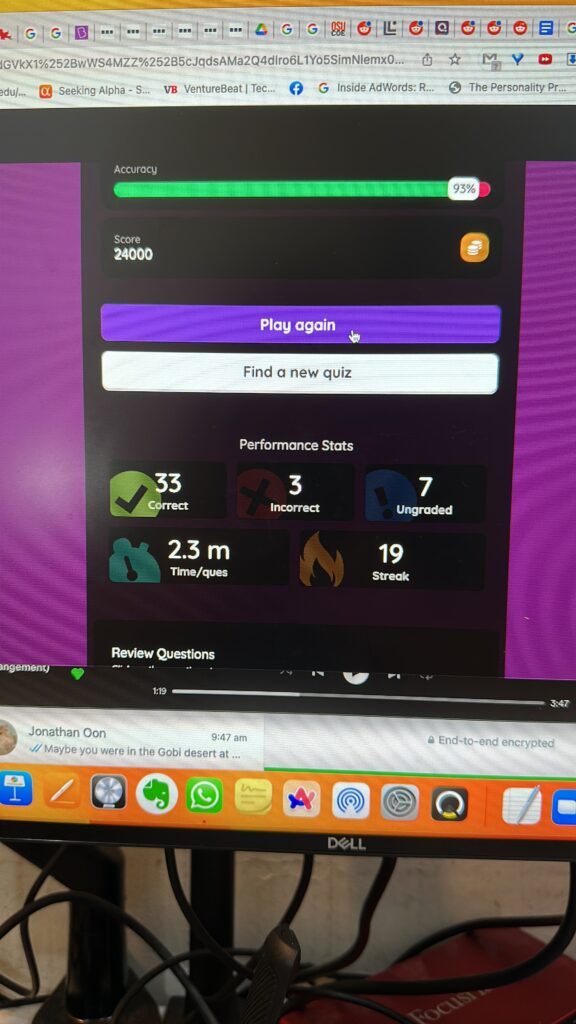
That’s a 73/100 since the graded MCQs account for 80 points, and 20 additional points come from the writing section (which has yet to be scored) – the passing score is 60 out of 100; I guess I pass!
Very tired, but very happy with the result – here’s to many more good things in days ahead, I guess!
Victor Tan here in the house hitting you with yet another AI post! Today, we’re talking about everyone’s favorite AI text generator! In case you’ve not heard of ChatGPT just yet for some reason, it’s an AI tool that can generate human-like text based on a given prompt. It’s a variant of the well-known GPT (short for “Generative Pre-training Transformer”) created by OpenAI.
ChatGPT got pretty viral recently because outlets like Forbes and Wall Street Journal have been writing articles about how it’s been generating essays in mere minutes that, if actually submitted, would definitely count as cheating.
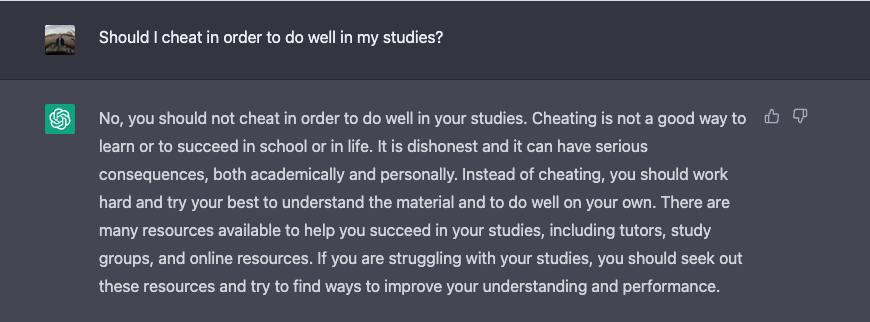
Here’s what ChatGPT says about that:
For this reason, ChatGPT’s received a fair bit of bad hype, and people seem confused about whether to accept, ignore, or vehemently reject it… It’s unclear that they know what to do about it.
WIth that in mind, it’s been fascinating to watch the different adaptation strategies of countries to the perceived challenge that ChatGPT has brought to the education system as well.
On one hand, some countries have responded with a strategy of mitigation. The state of New York banned ChatGPT (although how they could enforce it is questionable, considering that it’s possible to use ChatGPT on a home device), Australian universities have reverted to pen and paper exams.
That’s not all too surprising, especially since ChatGPT can definitely be used to cheat. It can write essays in mere seconds, craft grammatically well-structured summaries, and organize information to a dashingly effective degree. The craze has begun for AI writing detectors such as Edward Tian’s GPTZero that have yet to successfully and consistently identify AI generated text with a sufficient degree of accuracy to prevent false accusations: They are generally not very good yet, and an arms race is taking place between these detectors and AI text generators as we speak.
But mitigation is not the only strategy – and in an age where technology moves forward whether we like it or not, it seems to me only magical that is the approach we should pray for is one of adaptation. I believe that this is reflected in the strategy of Singapore, which has moved away from mitigation and more to adaptation, with specific allowances to learn how to ‘properly’ use tools such as ChatGPT.
With that said, if you’re a student, how can ChatGPT save your grades and help you have an easier school life without potentially putting you on the line for an F grade for plagiarism, or on review by a disciplinary committee?
Well, even if you don’t cheat with it, ChatGPT is an incredible tool that will help you move forward with your education in leaps and bounds.
Let me show you how!
ChatGPT can help you ace your studies by helping you to…
Provide explanations and examples:
Struggling with homework? ChatGPT can provide explanations and examples for various concepts, making it a great resource for completing those pesky assignments.
The reason that this is really helpful is that it helps you to contextualize the things that you’re learning rather than leaving them just as words, and to appreciate the connections between concepts and practicalities in a much more concrete way than you would otherwise experience if you were to just hear what the teacher is saying but not absorb it.
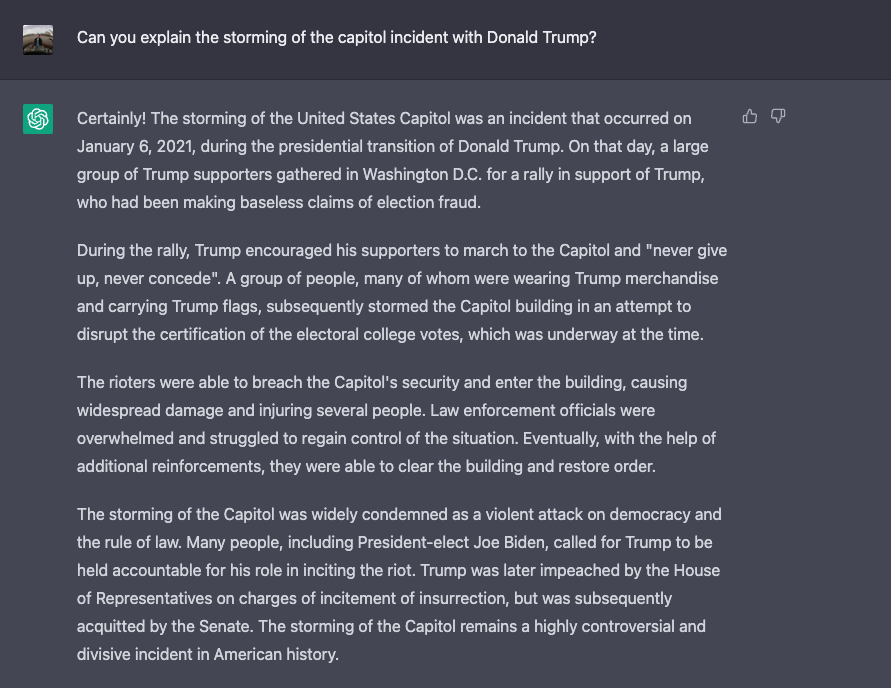
Let’s first start with a (very recent) historical example:
As you can see, the example here was well summarized, relatively balanced, and provides relatively factual information about what had happened albeit the matter remains controversial.
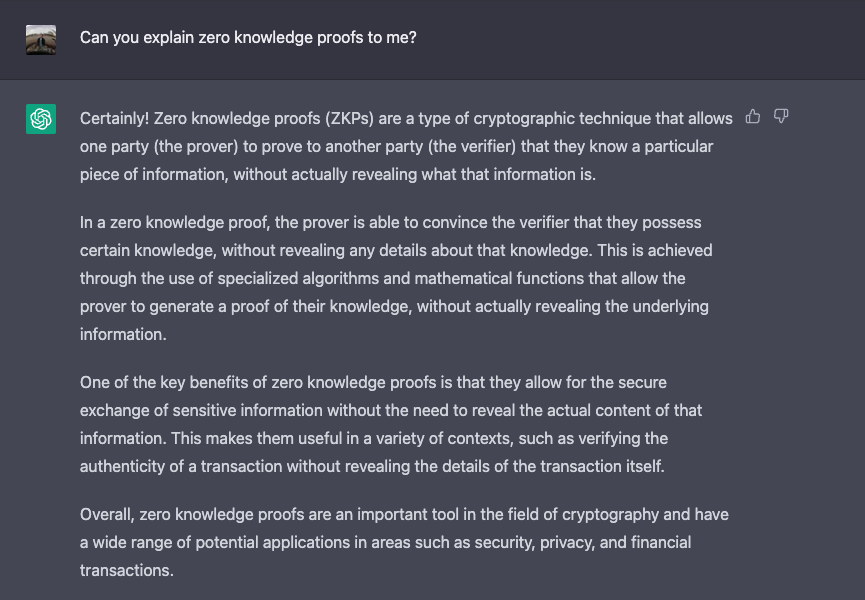
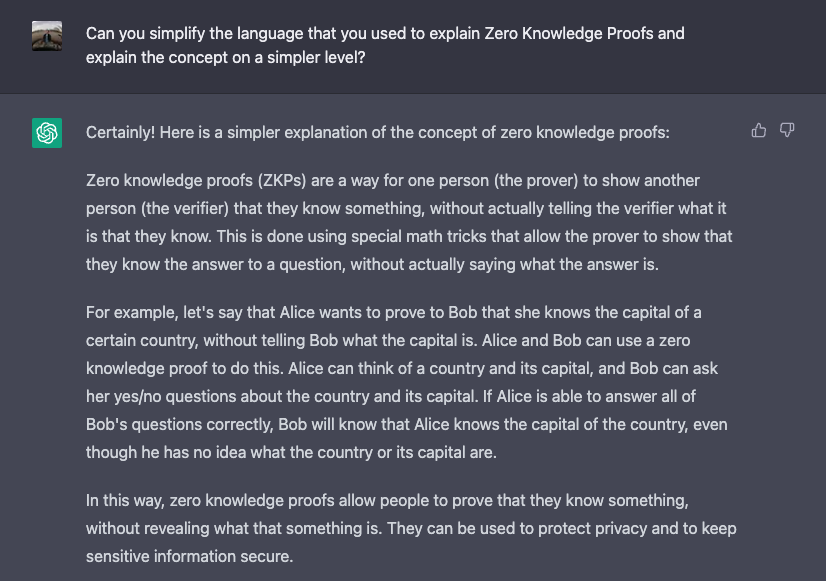
Next, here’s an example that might appeal to you future computer scientists, involving a cryptographic concept that I needed to brush up on:
Now that seems rather complicated, so let’s simplify it a bit.
That’s a bit better! You can do this with all sorts of things, so give it a try and see what you can do!
2. Help you to learn new things.
Want to learn more about a new subject? ChatGPT can provide a comprehensive overview, making it an excellent resource for expanding your knowledge.
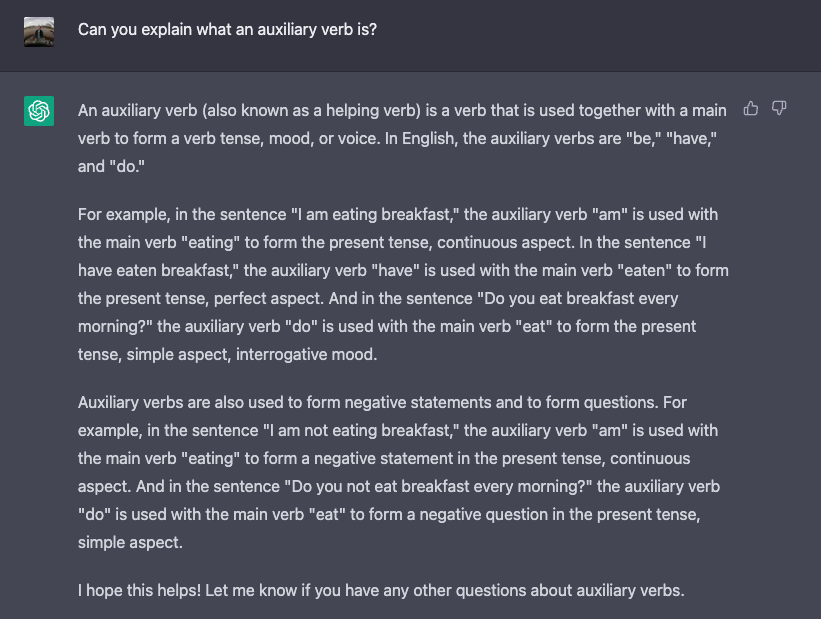
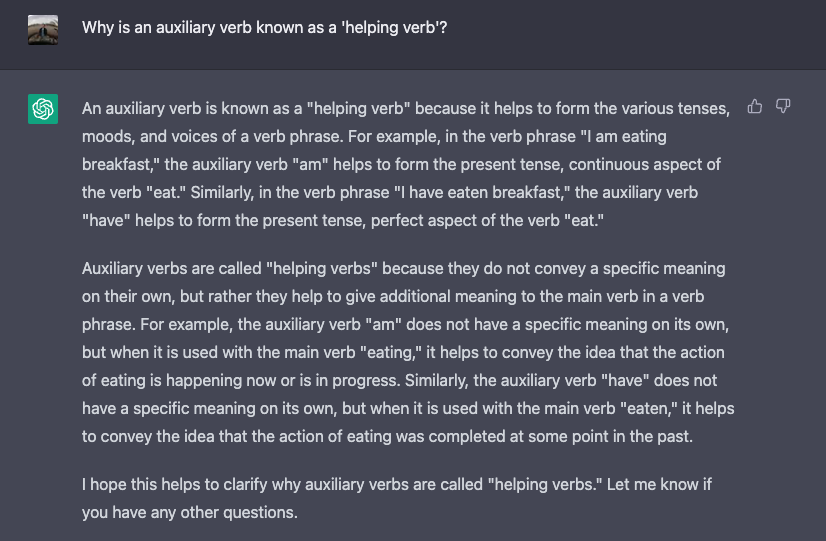
Also, because it is conversational, you can directly ask ChatGPT to explain certain things that it has raised in previous conversations, which will allow you to naturally understand the context of what you’ve learned about and even expand your learning in these areas.
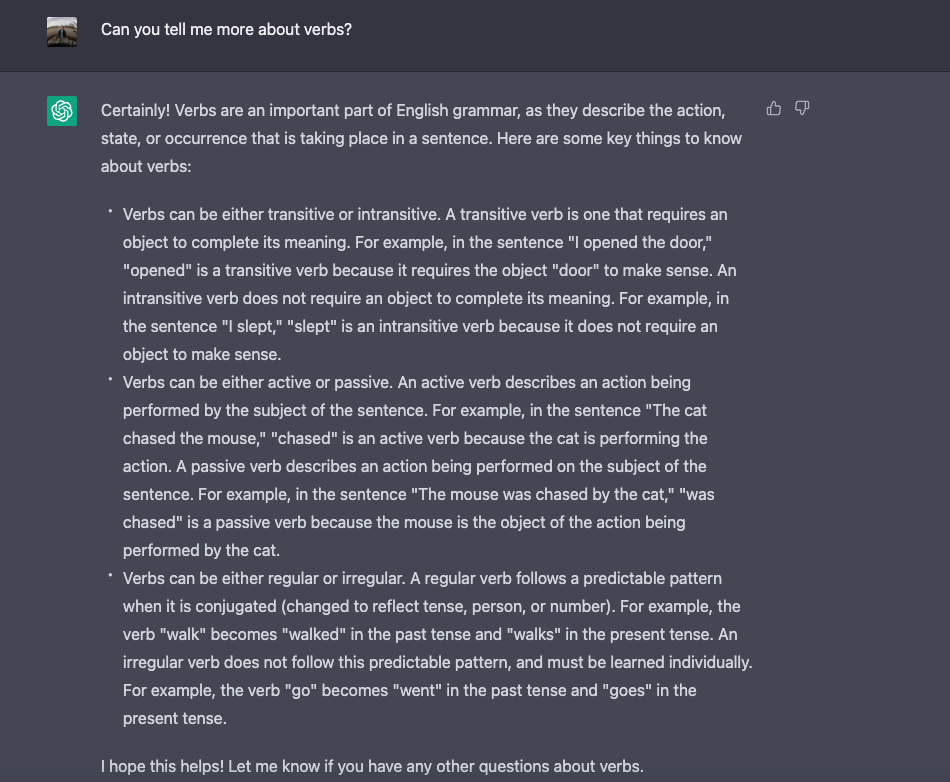
Here’s an example, featuring the English language 🙂
As you can see, I just had a conversation with ChatGPT, during which I learned a bit about verbs — ChatGPT was able to understand my requests for clarification and, when I asked for assistance in natural language, was able to extend my knowledge by providing me with even more information that I could in turn follow up on.
This is something that I would have found rather difficult to do with Google, as Google would have required me to make sense of the data that I find through the different links that I locate, and additionally impose more time costs on me in the form of time dedicated towards navigation — it is possible to learn and rather efficiently of course, but I would have to give ChatGPT the win in terms of ease of understanding and use here and hope that it shows you how efficiently you can learn with ChatGPT.
That being said, since it can help you learn, it’s only natural that ChatGPT can…
3. Help you to research things
Researching a paper or article? ChatGPT can generate summaries so you can get up to speed quickly and easily, which also means that you’ll be able to use it efficiently in connection with other tools such as search engines like Google in order to effectively research your tasks and plan out the things that you’d like to write for those otherwise arduous and pesky research essays.
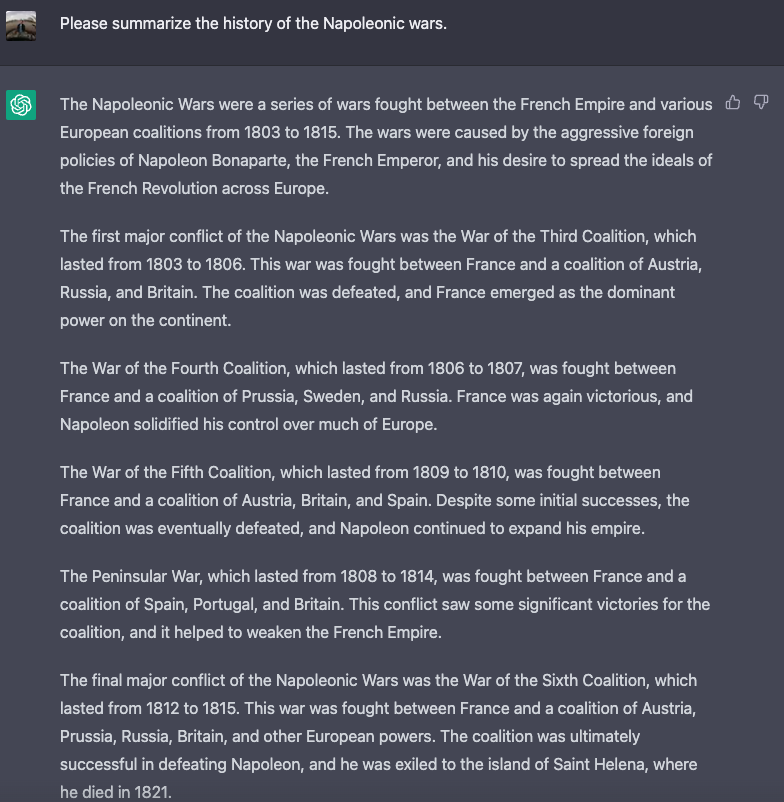
Here’s an example, featuring the Napoleonic Wars:
But speaking of the Napoleonic Wars…
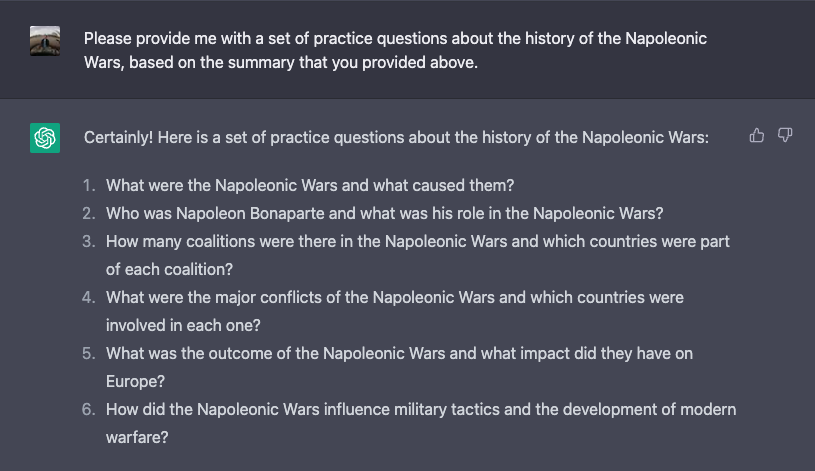
4. Providing practice questions:
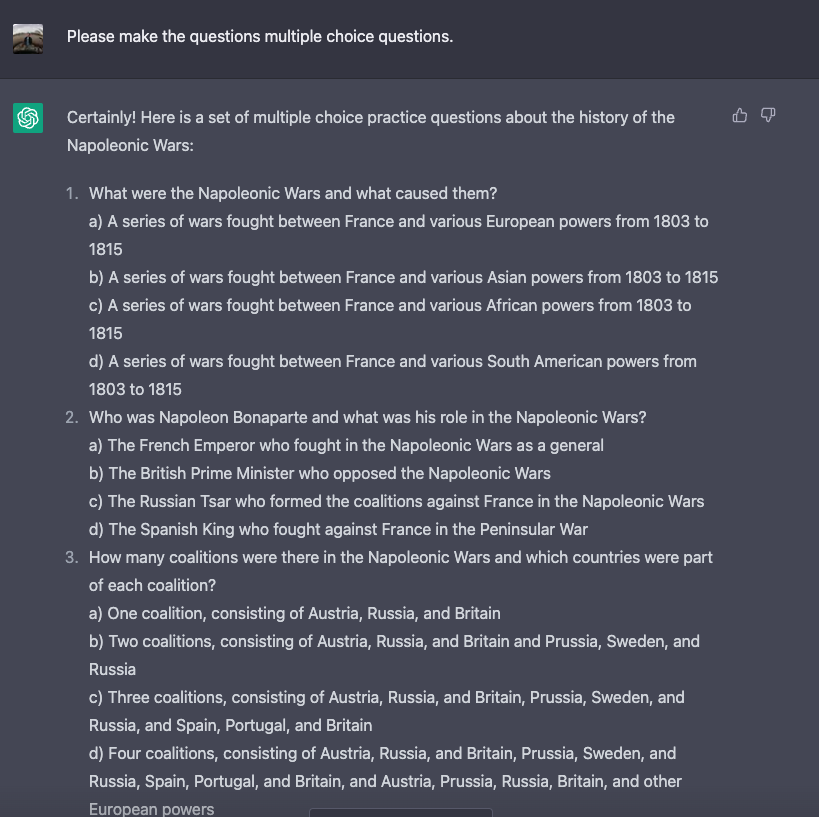
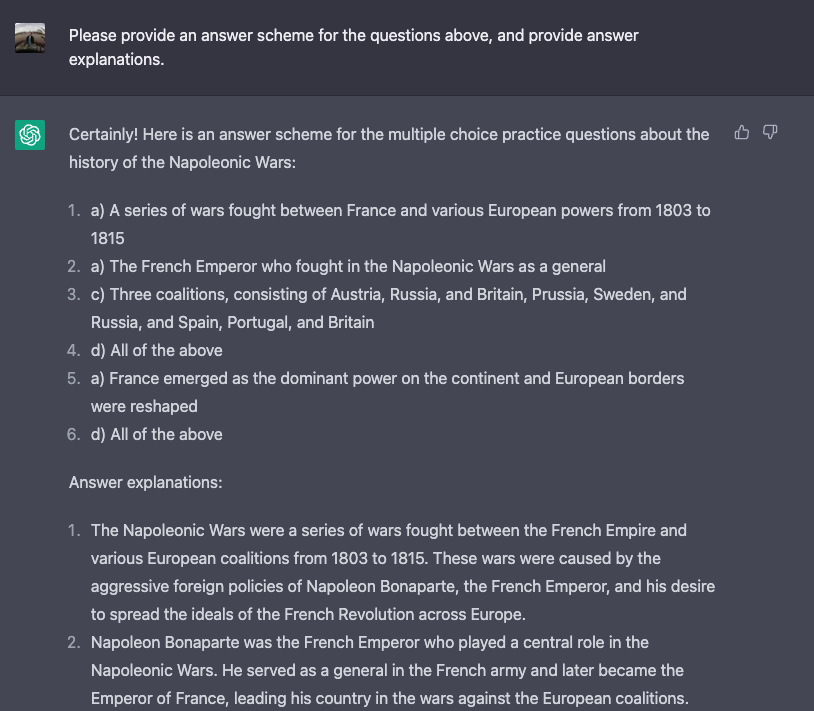
Need to prepare for an exam? ChatGPT can generate practice questions and provide in-depth explanations for the answers.
Let’s get back to the Napoleonic Wars example for a bit, and you’ll see what I mean.
As you can see, this is tremendously powerful — it is something that you can do with any historical concept or idea, and if you try it out, you’ll understand the sheer power of what it can provide even if you don’t cheat with it.
5. Writing essays:
This is probably the most controversial matter of all, because there is the highest potential for cheating with ChatGPT here.
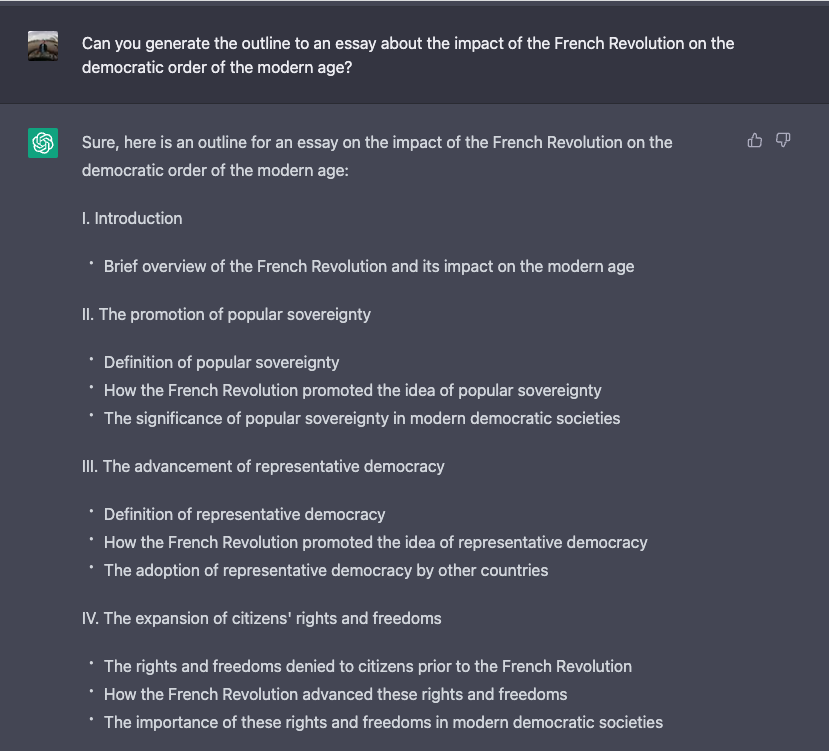
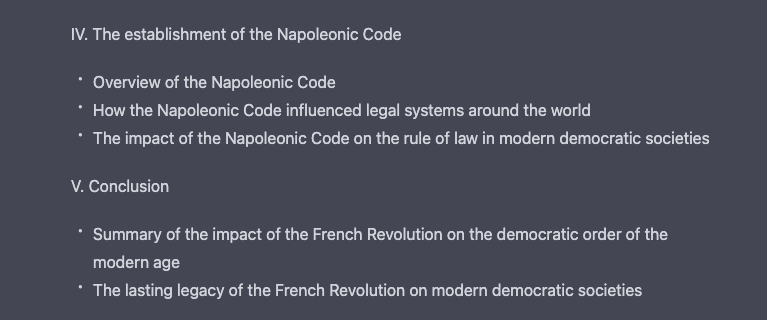
Still, ChatGPT can generate outlines, intro paragraphs, and body paragraphs, saving you time and effort in the process, by giving you a great starting point to begin your essay.
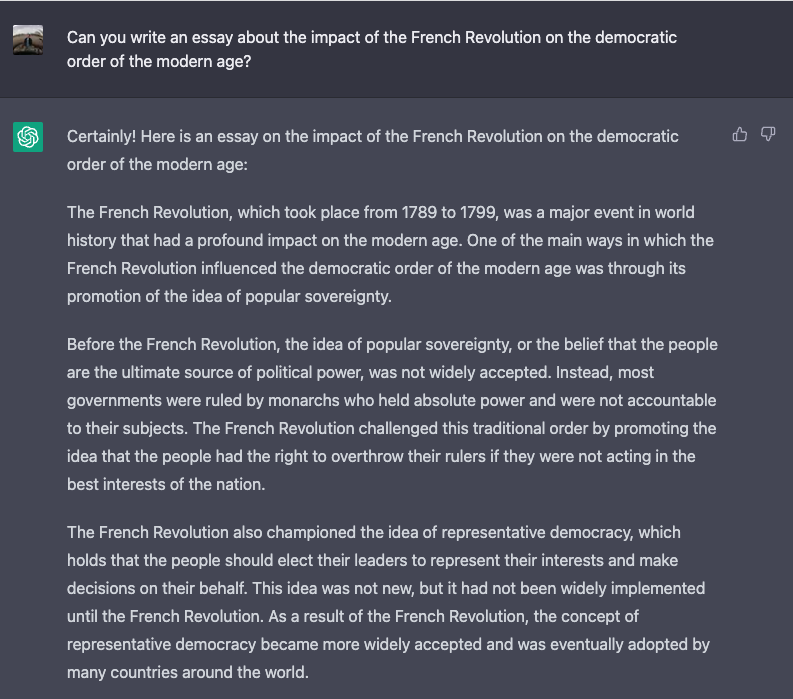
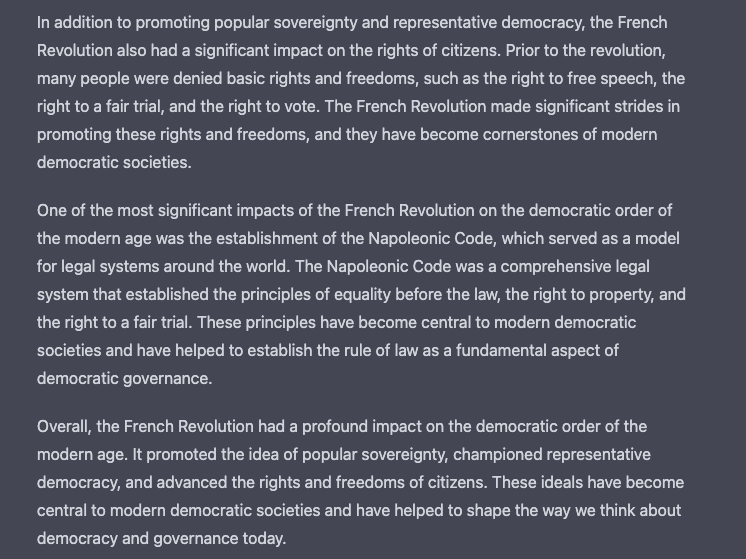
As you can see, ChatGPT can actually also write the essay for you.
The problem is, this works very well with factual essays, and if you do submit this as it is, it will definitely amount as cheating.
That said, there’s no harm in using AI to give you a sense of how to generate paragraphs, which in turn you can rewrite — I would observe, though, that the types of essays that you can generate well are many, and you can actually change the style of these essays in such a way that you may replicate the writing style of anyone with a significant body of work.
In order to use ChatGPT to improve your writing without cheating, you would have to have a sense of distinct voice and personality and also be able to add in some things to the essay that ChatGPT cannot actually execute on — that is especially relevant with things such as the college essay (I show this in my recent video, in which I wrote every single one of UChicago’s 2022–2023 essay prompts.)
For everything else, however, ChatGPT is generally capable of creating some pretty high quality output and proposing some pretty good essay structures, which can easily create the temptation to use that output vanilla — in other words, to cheat by having an algorithm do the work that you were assigned to do — when in reality, students would benefit more if they integrated their approach by not just relying on the outlines that they receive from this software, but instead also refining their thinking with the insights that arise from it.
Overall:
As you can see, ChatGPT is tremendously powerful for learning, and it can be used in many ways to help you learn information at a rate that is far greater than that which you might have if you were simply to make use of textbooks or Google to proceed through the slog of learning in a (relatively) unstructured way.
I’d like to concede, as a matter of fact, this post was actually partly generated by AI — but the reason I say partly is that I edited it pretty heavily after making use of the initial framework that it had created in order to elaborate on the different examples and to participate in actually using the software in order to demonstrate what it could do while taking screenshots — something that the AI is incapable of doing at this point in time.
At the same time, though, I must acknowledge that as a language model, ChatGPT is tremendously competent at compiling together summaries, outlines, research, and even writing essays for its users in ways that naturally make it rather tempting for students to cheat with ChatGPT, for the simple reason that it is incredibly easy to do so in lieu of learning with it.
Conclusion:
To conclude, I hope that you have enjoyed seeing some of the cool things that you can do with ChatGPT to extend your learning and the things that you can do with it, and that you will make use of it well to improve your life and knowledge.
That said, there is incredible potential within the ChatGPT technology and with AI at large to extend the capability of the human race, but there is equal potential to destroy it, subjugating our innate mental capacities and spirits to the idle temptations of creating and submitting a plagiarized AI essay for an A at the 11th hour and never actually doing the work.
Although cheating of this nature can seem harmless, my innocent musings lead me to wonder if cheating serves as a demonstration of how AI can essentially perform many of the tasks that human beings can do, and how some human beings will merely let them — thereby never ascending beyond their current level and merely allowing technology to resolve their problems either without asserting initiative or abiding poor planning and excuse-making in a realm where the tremendously sophisticated tools now available to us make such excuses effectively invalid.
Which is why, to me, AI seems to offer us two paths in the modern age, which in reality may well be the same path: that which leads to an era of greater learning and extension of our mental capabilities, or that which leads to our treating it merely as a tool to achieve our desired ends, thereby weakening ourselves in the process.
If you are a student, I would say this:
As human beings, I firmly believe we need to be able to double down, accepting what AI can do, and locating the gaps in between which we can find ourselves and locate the possibilities in which we are able to add value — a matter in which it is absolutely necessary to continue to develop ourselves by learning well, thinking critically, and making key decisions in terms of how to develop ourselves as the pace of technological innovation accelerates, and algorithms such as those that power ChatGPT only become increasingly advanced.
Even if there are solutions out there that enable you to pass off AI-generated essays as your own, do consider what you can do if you choose to let AI extend you rather than simply letting it be that which you owe credit to in the course of your academic career and by extension completely replace you in the thinking process; if you accept that without questioning it, fighting it, and growing rather than being subsumed by the tide that underpins it, then I guess you’d understand in that world, then, why I would think that while I feel that robots may not completely replace humans at large, the robots may at least replace you… Unless you let it reinforce your mind, rather than replace it.
As always, I wish for your best as a reader of this blog and as a fellow human being – thank you for reading, and we’ll talk more about the ways that AI can help education as a whole in the next post!