
Month: June 2026

The Privilege to Not Care

There’s a specific neoliberal idea that is very common in online content creation, and it’s one that online gurus tend to repeat one after another as if it were coordinated and they were all given the same script: “Post whatever it is that you want. Nobody is looking, nobody cares. You will get good along the way, so you should build the plane while you are flying it.”

At first glance, this seems like a wonderful idea.

After all, skill is built as a function of experience and multiple failures: It is not the fruit of overconsidered analysis paralysis manifesting itself into projects unfinished.

To thrive, it is said, you must survive each day and put yourself out into the world.

There’s a certain level of truth to that, which is probably why it has been repeated over and over again as if it were sage dogma.

But it seems to me that to believe that, a person participates in a profound act of privilege.

Yes, it is a privilege to not care.

Think about it.

To create for another person is to be judged. It is to be seen by the consciousness of another sentient being, to willingly submit yourself to another person’s gaze.

As human beings, we instinctively seek validation from those around us; for that reason, the act of creation can be viewed as a radical act of bravery.

If a person creates something, they dedicate time, effort, and energy to it.

Flashes of insight are compressed into moments of typing, painting, and writing as inwardly the creator gambles away that part of finite time never to be returned.

In a lifespan of fewer than a million hours—potentially by a difference of an order of magnitude depending on fortune and her acts—all the while wrestling with the possibility that what they may create will not match up to that which the machine could (that it can, that we as humans must reckon with), even as we race against ourselves in order to create something that we feel that other human beings may appreciate, given the estimator that is our own appreciation for it.

It is upon countless attempts on my part that this insight has risen to mind, failure after failure.

It is unlikely that a person will create if they are excessively perfectionist, but there is a caveat to that:

The very idea of excess implies that something is too much, and it provides no indication of what is correct or what is wrong.

If a person is truly an Olympic-class athlete, then would it be perfectionist for them to expect to run a mile in four minutes, given that they have enough training, experience, and the example of Roger Bannister and the hundreds of others who have achieved the same feat after it was once hypothesized that it was physically impossible?

Certainly, it would not be.

In other words, if you feel that something that you’re doing is not good enough, you can always train yourself so that you become better—good enough for your own exacting standards.

Of course, that assumes that you don’t pursue some of the other tantalizing options that are available.

The first of which is that you could just lower your standards, become what people call realistic.

In that sense, either that, or you could naturally gravitate towards that option of all comfortable options: give up. That is the default, the option by which the vast majority of human beings ply themselves.

There is no shame in weakness.

There is, however, a shame that one could say subsists in flying so close to the sun that your wings of wax melt.

But there are always those who are delusional, those who gaslight themselves:

Those who not only gaslight themselves but take in material that facilitates that phenomenal act. Thus the industry of online gurus proceeds, extends, and grows itself into a billion-dollar behemoth upon which the savvy entrepreneurs gorge, not because they are taking part in a deception necessarily, but rather in the interstice of plausible deniability that comes from the interaction between the fact that a person can only gain that which is worth earning through an act of effort:

The guru, however good, can never truly lead the initiate all the way to the finish line.

And so the roller coaster goes forward by a person’s efforts.

Statistically, the grind is harsh – It is a culling of the weak. The chaff is always and ever separated from the weak – but thriving, if a person should be fortunate enough to experience it, is exhilarating.

There is a distinction between thriving and feeling that one is thriving while celebrating in the midst of a delulu party; one never really knows when one has reached the crossing of the terminal point, that which separates the profane world from the sacred.

It is this process that gives rise to the duck syndrome, I suppose, where a person appears calm on the surface but in reality is paddling as fast as possible ahead under the water to move towards a goal of which they have no true concept.

Of course, the decision to participate in this grind is perhaps not entirely a person’s own.

Perhaps it is by dint of destiny or creation of personalities. Some might say that it is fate, self-cultivated or crafted together from random opportunities in a probabilistic universe.

It is hard to disconfirm any one of those things precisely because they are not really subject to experimentation – The science, if it were to be a science, is continually disrupted by the fact that the experimenter is always and ever trying to influence the outcome.

At the end of the day, what can really be said?

Perhaps it is just what I had said at the start.

It is a privilege to not care, to hold low standards for your life, to be able to accept the passing of life as waves over the sandy beach. Inevitable, as we may think, is the passage of time.

But I suppose it is also a privilege to be able to enjoy this. Maybe that is where the next stage of gaslighting exists, though—but perhaps that is a story for another day.
Hi it’s me again.

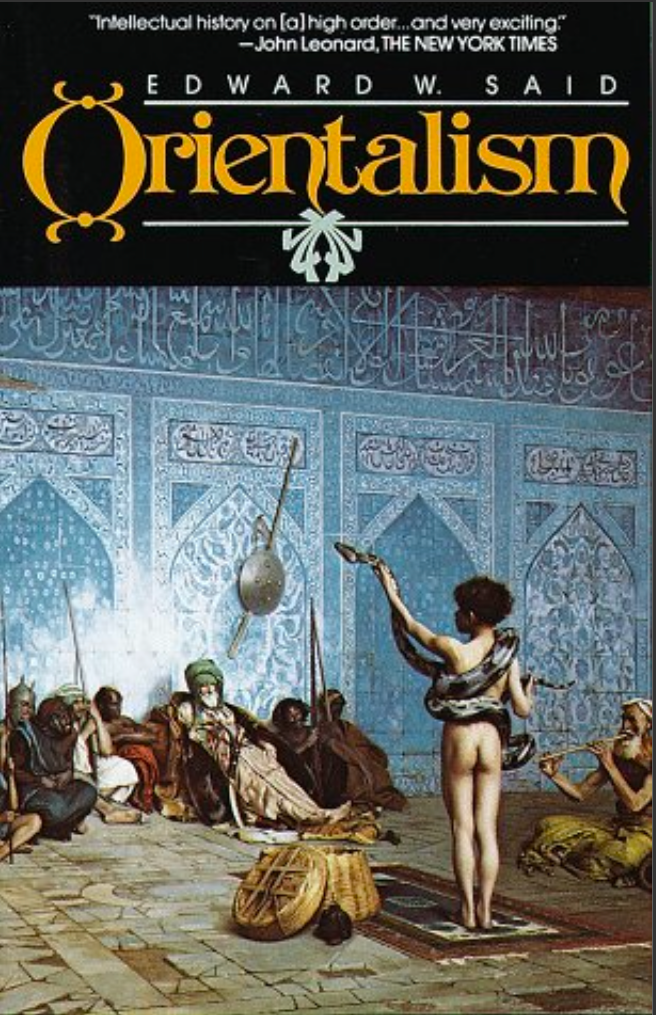
I finished Orientalism today, and it was truly unexpected that I would have. I was plodding along with the book as usual, maybe spending just a little bit of extra time. As I reached page 323 out of 378, fully expecting that the whole project would last much longer, I was shocked as I realized that everything beyond 327 was just page after page of references and indices for more than a hundred different citations, and ream after ream of definitions. Towards the end, it was, to say the very least, a strange anti-climax.

For better or for worse, I had somehow finished reading one of the grandest intellectual projects of the entire 20th century – Few books would make me reflect in this way or should give me a sense that I had learned something new that I considered worth passing on, but I am proud to say that Orientalism was one of those books. I talked about this in the last post, but it is strange to think about how we represent others, how those representations can be fair or foul, how they can distort our understanding of the world. I think that insight will go with me for much longer and it will always play a role in setting a small precursor check before I view or understand situations. 

I find myself now in a strange place, thinking about the different things there are to read ahead. The things I didn’t mention I was reading, even as I had neglected to mention the fact that I am right now in the middle of one of those flights of fancy, which I take once in a while, as I try to gain a certain mastery or understanding of the world, which I had not had before. 

The feeling doesn’t come all the time, but when it does come, it is quite intense, and here I am caught in the thick of it, looking at title after title from sociological tract after sociological tract. 

The old familiar names like Durkheim, Weber, Foucault, and Fanon are casually appearing, and the somewhat newer names like Manheim are mixing together with some old and vaguely familiar but perhaps never truly encountered ones like Adorno, Saussure, Heidegger, Kant, Nussbaum, and Levi Strauss, amongst others. Even as I mentally determined that the next book I will read is Homi K. Bhabha’s “The Location of Culture”. 

I don’t quite know when this phase will end, but what I do know is that the last time this happened, it continued for an entire year. 

I appeared in a newspaper that year after having read 350 books in a single year. 

I think it is unlikely that I will achieve that record again, because the books that I am looking up are much burn out. 

The ideas are more complex, the terms on which to compare reality with the visible sight that life has accorded now are of a higher resolution, and in my subjective evaluation, therefore requiring more depth, time, and apprehension along the winding garden paths.

To give you an idea of what that means, from Orientalism alone I started up at least 40 separate ChatGPT conversations just to understand what Said was talking about, learning words that I had not encountered before across multiple languages, to not even speak about English alone: 

I discovered again sociology of knowledge, location, subjectivities, and so many other things in new lights that have made me much more deeply think about the realities that we find ourselves in and how we create those. Professor Said has been a wonderful source of instruction in this regard, and his legacy, I think, does not need my validation, though today’s appreciation is not a paean – it is just a simple note of appreciation. 

Where will this take me and what will I eventually learn from it? It is hard to say, but from what I’ve seen, it never really is in the direction of something bad. I don’t really think in terms of good or bad. It just all seems natural, per the towers injunction that is in my WhatsApp status message for anyone who happens to know my phone number. 

Anyway, every story has an end, but this one seems to be being written, so I will not interrupt it. 

Diary Entryesque – Attempt #1

I really want to start treating this like a diary again. I have failed before, but hopefully this is a small success. If it does end up as a failure, you will notice because it won’t update. I will try. Failure is normal, it is expected, and I probably will again and again. Anyway, here’s my attempt.

One of the things that I’ve started to do is to read Edward Said’s Orientalism, and I think it is a fascinating book. It’s not often that I spend more than a single day reading a book, yet somehow I’ve been captivated by Professor Said’s scholarship. Reading it has become a daily activity for me. As I walk and I run, I read passage by passage, because it is just that interesting and that worthy of the evaluation on a day-to-day.

Interestingly, it’s also one of those things that makes me want to capture down what I think and what I don’t think, and not necessarily even in a perfect way. Even in searching the immediate impressions that it has left, I find that it has left so many different footprints which I have yet to completely explore or traverse.

What stands out most immediately is this idea of how representations shape reality, and how what we see is affected by the assumptions and the way that we think about this given world.

Amongst other things, it showed to me how just a few people can end up shaping how entire groups of people think of countries, nations, people, civilizations. I think that that is a fascinating insight, because, amongst other things, it is one of the beautiful embodiments of the realization that in any given society it is not necessarily the great mass of people who would decide how civilization would see itself.

Rather, it is only a few people who, although they might be limited in their access to the world at large, might somehow still end up shaping what people think about, appreciate, and eventually understand, in a game of what one might call—perhaps in a way that Professor Said would not approve of—Chinese whispers.

This is how we understand the world, one might say: the scholar or the like just read a book and decide that that is indeed how certain people are, how certain classes of people are, how others should see whether Christians, Muslims, Buddhists, people of every single race or religion, mediated through little representations made with sensors that we use to appreciate only small, local, and immediate parts of it.

It is quite surprising to think about this idea.

At least for me, it has been interesting, because I didn’t always reflect upon this: how, in fact, the things that we read end up distorting reality, even if they are meant to create factual representations of it. It is a funny insight.

I wonder if the books that I have read all this while have been giving me a false representation of the world.

Somehow or another, they feel as though they have not yet.

Somehow or another, a lot of the things that I have thought about have been confirmed by them.

Of course, maybe that’s one of the symptoms of being a victim of representations—or, if not a victim, then a selector of these representations and the things that they show to us.

It is also nice somehow to learn a whole ton of new words, and also about skills of thought, just because Professor Said mentions so many different concepts that I find interesting and that I find myself inclined to just research and understand for long stretches through the reading.

To say that I have synthesized everything would really be a lie, and I’m sure that this thought process is going to shift and evolve in response to new information in the days ahead.

For now, what I can say is that all of this is fun, and it’s nice to act like a student and also to write like one again.