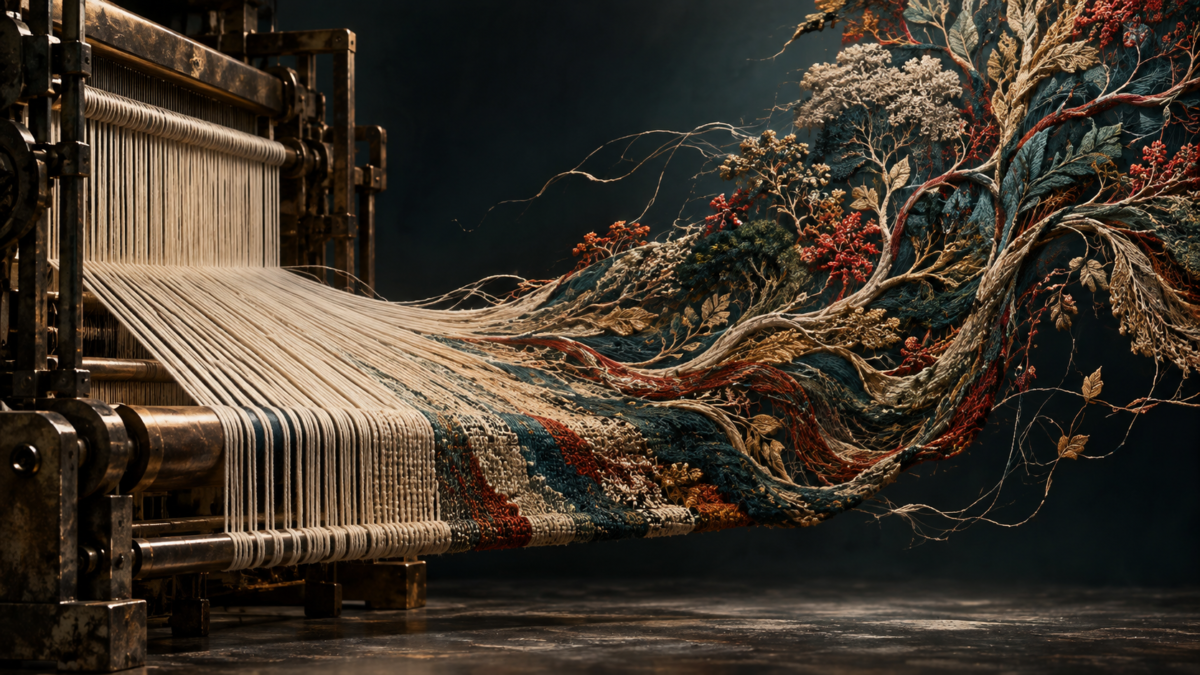
I find the word “text” an exceptionally interesting word for many different reasons, but the most immediate one that comes to mind is that its origin is from weaving; that’s where “textile” comes from, as well as the beautiful analogy that immediately appears between a well-written essay, book, or even video, and the finest fabrics of the world.
I find it exceptionally interesting how so many of us learn how we develop a concept of this thing we call ‘reality’ through texts – how messages between people structure and inform how we behave and relate to one another, how news stories and their angles shape how we see events and things; how videos on the doomscroll and the long horizon watch alike frame, affirm, reject, and even construct our entire viewpoints of what can be “known” about this given world.
But you know what’s EVEN more interesting than the two preceding paragraphs?
It’s the realization I have that in modern society, it would be silly for a person to reject all these things while declaring that they want to be purists – authentic, freed from the constraints of things, to only see or feel or interpret the world not according to the dictates of woven things, but instead in accordance with what each person thinks, sees, feels for themselves.
To be fair, it is a tempting thought – that if you could just disconnect from a connected world, from social media, images, videos, that you would suddenly find yourself in the company of a pure nature or a truer version of yourself.
But can you?
Whether we like it or not, we live in a world with other people whose behaviors affect us and influence us – if other people are influenced by texts in how they relate, behave, or think about either us or the world, then our lives will surely be affected by texts and what they say; this isn’t even considering how texts can educate and improve people, how knowledge and the quality of our materials affects the possibility that we might develop abilities that are of interest and in ways that lie beyond mere opinion; this also isn’t considering how decisions are made and shaped in the political dimension or academia, where the limits of knowability and how it is measured, improved, validated, are in turn encapsulated by multiple overlapping frameworks with different intersubjective relevance that operate within a scope and field of power – each to its own domain as unto others.
What is most interesting to me at this stage, perhaps, is the question of how far it is really possible to know the world through text – where the true boundary is, where the limits are, and whether it is even sensible to ask such a question.
I don’t know the answer to that question, but it is a fun one to think about and to ground myself with.
A person cannot know the world entirely through books, yet it would be illogical and ill-advised for them to simply live away from them or from their shorter, less intense, yet equally textual variants, each of which still articulates the world in miniature from its own, respective viewpoint.
Where is the happy median point here?
I would love to know.